Channels
DV Music Language – Full Guide for This Demo (v1)
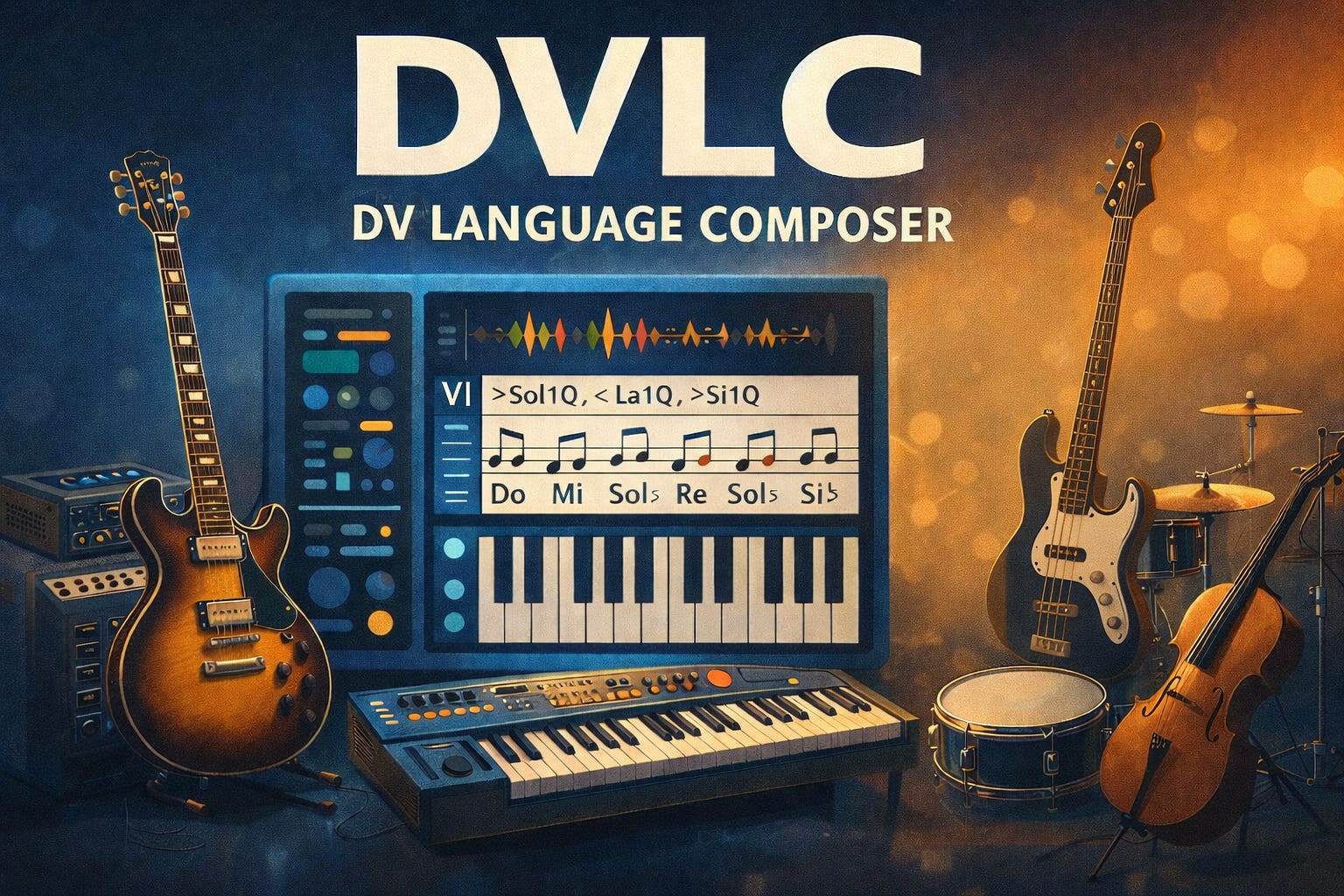
DV Language (David’s Violin Language) is a modern textual music notation system. Instead of writing notes on a staff, you write them as text: notes, octaves, durations, chords, rests, slides, drums, degrees and more. This demo lets you listen to DV notation with multiple channels.
Index
- Quick Start – Minimal Example
- Boxes, Beats & Tick Math
- Notes, Octaves, Accidentals & Durations
- Rests & Full-Box Mute
- Repeats
|: ... :| - Slides and bends
LEFT-S-RIGHT/LEFT-B-RIGHT - Chords – DV Style & Western Symbols
- Degree Mode (1, 2, 3… + octaves)
- Frequency Mode (440Hz, 523.25Hz)
- Piano Right / Left Hand
- Triplets & Tuplets
- Pedal Overlay – Independent Durations with
+ - Drums & Percussion Shorthand
- Export & Print
- Multilingual Solfège Example
- Spillover Notes (Carry Across Boxes)
- Open-Domain Example Library (Traditional / Public Domain)
- Example Library – Legal Note
- About DVLCO & Official DV Language Documentation
- Legal Notice & Intellectual Property
1. Quick Start – Minimal Example
Copy–paste this into one channel (instrument = Piano) and press Play:
| Do4Q ; Mi4Q ; Sol4Q ; Do5Q
| Do5Q ; Sol4Q ; Mi4Q ; Do4Q ||Do4Q= note Do, octave 4, quarter note.- Two boxes = two bars. In 4/4, each box is 4 quarter notes.
||is recommended only at the very end of the piece.
2. Boxes, Beats & Tick Math
DV Language in this demo uses boxes instead of standard barlines. A box is a bar of time with a fixed tick capacity.
- Recommended copy–paste style for this demo: each box starts with
|on a new line. - To avoid accidental parsing of
|\n|as||, we do not end each line with|in guide examples. - Use
||only at the end of the final box. - Tokens inside a box are separated by
;or,.
Time resolution (ticks):
W = 96 ticksHalf (1/2) =
H = 48 ticksQuarter (1/4) =
Q = 24 ticksEighth (1/8) =
E = 12 ticksSixteenth (1/16) =
S = 6 ticks32nd (1/32) =
T = 3 ticks
Box capacity =
beatsPerBox × 24 ticks.
Example: 4/4 → beatsPerBox = 4 → box must total 96 ticks.
The engine checks that the sum of durations in each box equals the box capacity. If not, the box is marked as an error (timing mismatch).
3. Notes, Octaves, Accidentals & Durations
Basic format: NoteOctaveDuration
Do4Q– Do, octave 4, quarter.Re5E– Re, octave 5, eighth.Mi3H– Mi, octave 3, half.
Note names (Latin style):
- Solfège:
Do Re Mi Fa Sol La Si. - Letter names:
C D E F G A B. Do4QandC4Qare essentially the same pitch.
Accidentals: can be written before or after the octave:
Do#4Q   Do4#Q   Dob4Q   Do4bQ
C#4Q    C4#Q    Cb4Q    C4bQ
# / ♯ and b / ♭ are accepted (depending on font / input method).
Durations – letter form:
W– whole.H– half.Q– quarter.E– eighth.S– sixteenth.T– 32nd.
Durations – fractional form:
(1/1),(1/2),(1/4),(1/8),(1/16),(1/32).- Example:
Do4(1/4)= quarter note, 24 ticks.
Dotted durations * (extend by half):
Q*=Q + E(dotted quarter).H*=H + Q(dotted half).(1/4)*= quarter + eighth.(1/8)*= eighth + sixteenth.
Examples (copy–paste):
| Do4Q* ; Re4E ; Mi4Q ; Fa4Q
| Sol4H* ; Mi4Q ; Re4Q ||
4. Rests & Full-Box Mute
Full-bar mute: any of these alone in a box fills the entire bar:
| 0
| Rest
| R
| Mute
| M
| MW ||
Partial rests / mutes:
RestQ,RestE,Rest(1/4).0H,0Q, etc.MuteQ,M(1/8),MQ.
Example (copy–paste):
| Do4Q ; RestQ ; Mi4Q ; RestQ
| 0 ||
5. Repeats |: ... :| (Plays Twice in Demo v1)
Repeats are written with |: (start) and :| (end).
In this demo:
each repeat section is played twice (one repeat level).
5.1 Single-box repeat
|: Do4Q ; Mi4Q ; Sol4Q ; Mi4Q :|Playback: that one box is played twice.
5.2 Multi-box repeat group
|: Do4Q ; Mi4Q ; Sol4Q ; Mi4Q
| Do5H ; Si4H :|
Here the repeat section is two boxes long. Playback: box 1 & box 2, then again box 1 & box 2.
5.3 Repeats + continuation
|: Do4Q ; Mi4Q ; Sol4Q ; Mi4Q
| Do5H ; Si4H :| Do5Q ; Do5Q ; Do5Q ; Do5Q ||
Playback: (boxes 1–2 twice) then the last box once.
Demo v1: no nested repeats and no alternative endings yet. Use simple repeat blocks only.
6. Slides and bends LEFT-S-RIGHT / LEFT-B-RIGHT
A slide or bend connects two notes or two degrees with one continuous pitch movement.
Use LEFTDUR-S-RIGHTDUR for a slide and
LEFTDUR-B-RIGHTDUR for a bend.
Examples (notes):
| Do4E-S-Mi4E ; Fa4E-S-Sol4E ; Do5H
| Sol4Q-S-Do5Q ; Do5Q-S-Si4Q ||
Examples (bends):
| Do5Q-B-Si4Q ; Sol4E-B-La4E ; Do5Q
| 5Q-B-6Q ; 3E-B-4E ; 1Q ||
Examples (degree mode):
| 1Q-S-3Q ; 5Q-S-1.1Q
| 2E-S-3E ; 4E-S-5E ; 6H ||- The left duration holds the starting pitch; the right duration is the audible transition window.
- A slide moves through the entire right duration. A bend reaches the target earlier and holds it briefly.
- Both durations are added together and must fit inside the tick math like any other notes.
- Slides and bends can appear anywhere inside the box, separated by
;or,.
7. Chords – DV Style & Western Symbols
7.1 DV chord notation (explicit pitches)
Combine notes with + and put a duration at the end:
| Do4+Mi4+Sol4Q ; Fa4+La4+Do5Q
| C4+E4+G4H ; F4+A4+C5H ||- All notes in a
+group share the same duration. - The group must fit inside the box capacity as usual.
7.2 Western chord symbols (root + quality)
Root is a note name (C, D, E, F, G, A, B with accidentals), plus a chord quality and duration:
| CQ ; CmajQ ; C7Q ; CmQ
| Fsus4H ; G7H ||
Supported qualities in Demo v1 (as intent):
C,Cmaj– major.Cm– minor.Cdim– diminished.Caug– augmented.C7,Cmaj7,Cm7,CmMaj7.Cdim7, half-diminishedCø7/Cm7b5(implementation may still be refined).Csus2,Csus4– suspended chords.
Internally, the engine builds voicings from the root and quality. Exact voicings can be refined in future versions; syntax here reflects the intended DV Language behavior.
8. Degree Mode (1, 2, 3… + octaves)
Each channel can switch its Input mode between: Notes (Do/Re/C4…) and Degrees (1, 2, 3…). In degree mode, you no longer write C, Do, etc. — you write scale-degree numbers.
8.1 Basic degrees
1Q,2Q,3Q,4Q,5Q,6Q,7Q– scale degrees 1–7.8Q,9Q,10Q,13Q– extended degrees.- Negative degrees go backwards:
-1Q,-2Q, etc.
The channel defines: Root (C, D, E…, with accidentals), Scale type (major, natural minor, etc.), and Root octave. Degrees are mapped from this.
8.2 Octave modifiers on the degree
1.0Q– degree 1 in the base octave.1.1Q– degree 1, one octave above.1.(-1)Q– degree 1, one octave below.- Same for any degree:
5.1Q,7.2Q,3.(-2)Q, etc.
8.3 Degree accidentals
1#Q,2bQ,3#Q,6bQ, etc.- Also with octaves:
1#.1Q,4b.(-1)Q.
8.4 Chords in degree mode
Use + exactly like in DV pitches, but with degrees instead of notes:
| 1+3+5Q , 2+4+6H, 4+6+1.1Q
| 1.(-1)+3.(-1)+5.(-1)H , 5+7+2.1H ||
Examples (copy–paste for a C major scale):
| 1Q ; 2Q ; 3Q ; 4Q
| 5Q ; 6Q ; 7Q ; 1.1Q ||
Internally the engine converts degrees to real notes (MIDI pitches) using the channel’s root, scale and octave.
8b. Frequency Mode (440Hz, 523.25Hz)
DVLC can also read direct frequencies. Set a channel to Input mode = Frequencies
and write values such as 440HzQ, 523.25HzQ, 660HzH,
or plain numeric values like 440Q.
- The same duration rules still apply.
- Frequency mode is useful when you want exact pitch values instead of note names.
- Degree controls stay hidden in this mode because pitch comes directly from the entered Hz values.
| 440HzQ ; 493.88HzQ ; 523.25HzQ ; 587.33HzQ
| 659.25HzH ; 523.25HzQ ; 440HzQ ||
9. Piano Right / Left Hand (Per Channel)
- Set the channel instrument to Piano.
- You will see two text areas: one for right hand, one for left hand.
- Enable or disable “Play both hands together (Piano)”.
- Both hands share the same tempo, meter, mode (notes vs degrees) and scale settings.
Example (copy–paste concept):
Right hand:
| Do4Q ; Mi4Q ; Sol4Q ; Do5Q
| Do5Q ; Sol4Q ; Mi4Q ; Do4Q ||

Left hand:
| Do3H ; Sol2H
| Do3H ; Sol2H ||
10. Triplets & Tuplets
Use the same triplet structure as the DV Player: write 3 immediately
after the duration. Examples: Do4Q3, Re4E3, Mi4S3.
The 3 suffix divides the written duration by three, so Q3
is one third of a quarter note.
Twelve Q3 notes fill one 4/4 box—three in every quarter:
| Do4Q3 ; Re4Q3 ; Mi4Q3 ; Fa4Q3 ; Sol4Q3 ; La4Q3 ; Si4Q3 ; Do5Q3 ; Si4Q3 ; La4Q3 ; Sol4Q3 ; Fa4Q3 ||Triplet rests and percussion use the same suffix: RestQ3, 0E3, KQ3.
The older indexed [i/n] tuplet spelling remains accepted for compatibility.
11. Pedal Overlay – Independent Durations with +
A single staff can contain a long pedal or cantus note while shorter notes move above it. The Composer now plays these as real overlapping durations; this is no longer only a visual “fake sustain” trick.
Core rule: when every element around + has its own duration,
every note keeps that duration and the next ; event begins after the shortest one.
Example 1 – Pedal Mi + moving line (start together, 4/4)
Musical idea: Mi₃ holds for the whole bar, while Mi₄–Fa₄–Sol₄–Mi₄ are quarters above it.
| Mi3W + Mi4Q ; Fa4Q ; Sol4Q ; Mi4Q ||Interpretation: Mi₃ and Mi₄ begin together. Mi₃ remains audible for all four beats, while Mi₄, Fa₄, Sol₄ and Mi₄ form the moving quarter-note line.
Rule of thumb:
- Use
+for notes that start together. - Use
;when notes happen in sequence inside the box. Do4+Mi4+Sol4Qremains the shared-duration chord form.Mi3W + Mi4Qis the independent-duration pedal-overlay form.
12. Drums & Percussion Shorthand
These stems are recognized on any channel, but sound best when the channel instrument is set to Drums or Cymbals/Triangle.
| Stem | Family | Examples |
|---|---|---|
K (kick) | membrane | KQ, KE, KS |
S (snare) | membrane | SQ, SE |
T1/T2/T3 (toms) | membrane | T1Q, T2E, T3S |
Rm (rim) | membrane | RmE |
Cl (clap) | membrane | ClQ |
Hh (closed hat) | metal | HhE, HhS |
Ho (open hat) | metal | HoQ, HoE |
Cr (crash) | metal | CrH, CrQ |
Tr (triangle) | metal | TrQ, TrH |
12.1 Groove examples (copy–paste)
| KQ ; SQ ; KQ ; SQ ||Hi-hat 8ths + kick-snare layer
Channel 1 (Hats):
| HhE ; HhE ; HhE ; HhE ; HhE ; HhE ; HhE ; HhE ||Channel 2 (Kick/Snare):
| KQ ; 0Q ; KQ ; 0Q ||
If KQ ; SQ sounds too thin with a melodic instrument,
switch the channel to “Drums” for membrane and “Cymbal/Triangle” for metal.
13. Export & Print
- Per channel MP3/WAV – “Export Channel (MP3) 💾” on the channel.
- Per channel MIDI – “Export Channel (MIDI) 🎼”.
- Full mix MP3/WAV – “Export Full Mix (MP3 / WAV) 💾”.
- Full mix MIDI – “Export Full Mix (MIDI) 🎼”.
- Print – “Export Score” per channel, or “Export Score”.
14. Multilingual Solfège Example (Do4 → Do5)
DV Language is designed to work with many languages and scripts. Internally they all map to the canonical solfège Do Re Mi Fa Sol La Si.
Supported solfège families + letter notation in this demo (intent)
- English / Latin-based: Do Re Mi Fa Sol La Si
- French / Spanish / Portuguese (accented): Dó Ré Mí Fá Sol Lá Sí
- Filipino / Tagalog: Do Re Mi Fa Sol La Ti (Ti interpreted as Si)
- Chinese: 哆 来 咪 发 唆 拉 西
- Korean: 도 레 미 파 솔 라 시
- Japanese: ド レ ミ ファ ソ ラ シ
- Russian: До Ре Ми Фа Соль Ля Си
- Hindi: सा रे ग म प ध नि
- Thai: โด เร มี ฟา ซอล ลา ซี
- Vietnamese: Đô Rê Mi Fa Sol La Si
- English / International letter notation: C D E F G A B
Same melody, different scripts (copy–paste any)
English / Latin-based
| Do4Q ; Re4(1/4) ; Mi4Q ; Fa4(1/4) | Sol4Q ; La4Q ; Si4Q ; Do5Q ||
French / Spanish / Portuguese (accented)
| Dó4Q ; Ré4(1/4) ; Mí4Q ; Fá4(1/4) | Sol4Q ; Lá4Q ; Sí4Q ; Dó5Q ||
Filipino / Tagalog
| Do4Q ; Re4(1/4) ; Mi4Q ; Fa4(1/4) | Sol4Q ; La4Q ; Ti4Q ; Do5Q ||
Chinese
| 哆4Q ; 来4(1/4) ; 咪4Q ; 发4(1/4) | 唆4Q ; 拉4Q ; 西4Q ; 哆5Q ||
Korean (Hangul)
| 도4Q ; 레4(1/4) ; 미4Q ; 파4(1/4) | 솔4Q ; 라4Q ; 시4Q ; 도5Q ||
Japanese (Katakana)
| ド4Q ; レ4(1/4) ; ミ4Q ; ファ4(1/4) | ソ4Q ; ラ4Q ; シ4Q ; ド5Q ||
Russian (Cyrillic)
| До4Q ; Ре4(1/4) ; Ми4Q ; Фа4(1/4) | Соль4Q ; Ля4Q ; Си4Q ; До5Q ||
Hindi (Devanagari)
| सा4Q ; रे4(1/4) ; ग4Q ; म4(1/4) | प4Q ; ध4Q ; नि4Q ; सा5Q ||
Thai
| โด4Q ; เร4(1/4) ; มี4Q ; ฟา4(1/4) | ซอล4Q ; ลา4Q ; ซี4Q ; โด5Q ||
Vietnamese
| Đô4Q ; Rê4(1/4) ; Mi4Q ; Fa4(1/4) | Sol4Q ; La4Q ; Si4Q ; Đô5Q ||
15. Spillover Notes (Carry Across Boxes)
In DVLCO, note durations follow traditional music timing. This means a note can be longer than the remaining space in the current box. When that happens, the note spills over (continues) into the next box automatically.
-
A box still has a fixed capacity:
beatsPerBox × 24ticks. - If a token’s duration is longer than what remains in the current box, the engine places the remaining part of that duration at the start of the next box.
- Because of that carry, the next box starts with some time already used, so you must write only the remaining time to complete that box (or mute/rest it).
Example (4/4):
| Do4Q : Do5W
| Sol4Q ; Mi4Q ; Do4Q ||- In 4/4, each box = 4 quarters.
Do4Quses 1 quarter, leaving 3 quarters in box 1.Do5Wis 4 quarters total, so it fills the remaining 3 quarters of box 1 and carries 1 quarter into the next box.- Therefore box 2 has only 3 quarters left, which matches:
Sol4Q ; Mi4Q ; Do4Q.
Example (3/4):
| Do5W
| Mi4Q ; Do4Q ||- In 3/4, each box = 3 quarters.
Do5Wis 4 quarters, so it fills box 1 (3 quarters) and carries 1 quarter into box 2.- So box 2 has only 2 quarters left, which matches:
Mi4Q ; Do4Q.
Separators: inside a box you can separate tokens using ;, ,, and also :.
They are treated the same (readability only).
16. Open-Domain Example Library (Traditional / Public Domain)
These are traditional melodies commonly taught worldwide. Use them as practical demo material. (They are included here as “traditional / public domain style” examples for learning and testing.)
Project A — “Frère Jacques” (Traditional) — Piano RH/LH + Strings + Percussions
Channel 1 — Piano (Right hand)
| Do4Q ; Re4Q ; Mi4Q ; Do4Q
| Do4Q ; Re4Q ; Mi4Q ; Do4Q
| Mi4Q ; Fa4Q ; Sol4H
| Mi4Q ; Fa4Q ; Sol4H
| Sol4E ; La4E ; Sol4E ; Fa4E ; Mi4Q ; Do4Q
| Sol4E ; La4E ; Sol4E ; Fa4E ; Mi4Q ; Do4Q
| Do4Q ; Sol3Q ; Do4H
| Do4Q ; Sol3Q ; Do4H ||
Channel 2 — Piano (Left hand)
| Do3H ; Sol2H
| Do3H ; Sol2H
| Do3H ; Sol2H
| Do3H ; Sol2H
| Do3H ; Sol2H
| Do3H ; Sol2H
| Do3H ; Sol2H
| Do3W ||
Channel 3 — Strings (Pad chords)
| Do4+Mi4+Sol4W
| Do4+Mi4+Sol4W
| Do4+Fa4+La4W
| Do4+Fa4+La4W
| Do4+Mi4+Sol4W
| Do4+Mi4+Sol4W
| Do4+Mi4+Sol4W
| Do4+Mi4+Sol4W ||
Channel 4 — Percussions (Backbeat + Hats)
| KE+HhE ; HhE ; SE+HhE ; HhE ; KE+HhE ; HhE ; SE+HhE ; HhE
| KE+HhE ; HhE ; SE+HhE ; HhE ; KE+HhE ; HhE ; SE+HhE ; HhE
| KE+HhE ; HhE ; SE+HhE ; HhE ; KE+HhE ; HhE ; SE+HhE ; HhE
| KE+HhE ; HhE ; SE+HhE ; HhE ; KE+HhE ; HhE ; SE+HhE ; HhE
| KE+HhE ; HhE ; SE+HhE ; HhE ; KE+HhE ; HhE ; SE+HhE ; HhE
| KE+HhE ; HhE ; SE+HhE ; HhE ; KE+HhE ; HhE ; SE+HhE ; HhE
| KE+HhE ; HhE ; SE+HhE ; HhE ; KE+HhE ; HhE ; SE+HhE ; HhE
| KE+HhE ; HhE ; SE+HhE ; HhE ; KE+HhE ; HhE ; SE+HhE ; HhE ||
Project B — “Twinkle Twinkle Little Star” (Traditional) — Piano RH/LH
Channel 1 — Piano (Right hand)
| Do4Q ; Do4Q ; Sol4Q ; Sol4Q
| La4Q ; La4Q ; Sol4H
| Fa4Q ; Fa4Q ; Mi4Q ; Mi4Q
| Re4Q ; Re4Q ; Do4H
| Sol4Q ; Sol4Q ; Fa4Q ; Fa4Q
| Mi4Q ; Mi4Q ; Re4H
| Sol4Q ; Sol4Q ; Fa4Q ; Fa4Q
| Mi4Q ; Mi4Q ; Re4H
| Do4Q ; Do4Q ; Sol4Q ; Sol4Q
| La4Q ; La4Q ; Sol4H
| Fa4Q ; Fa4Q ; Mi4Q ; Mi4Q
| Re4Q ; Re4Q ; Do4H ||
Channel 2 — Piano (Left hand)
| Do3H ; Sol2H
| Fa2H ; Do3H
| Fa2H ; Do3H
| Sol2H ; Do3H
| Sol2H ; Do3H
| Sol2H ; Re3H
| Sol2H ; Do3H
| Sol2H ; Re3H
| Do3H ; Sol2H
| Fa2H ; Do3H
| Fa2H ; Do3H
| Sol2H ; Do3H ||
Project C — “Greensleeves” (Traditional) — Guitar + Piano RH/LH + Percussions
Channel 1 — Guitar (Melody)
| La4Q ; Do5Q ; Re5Q ; Mi5Q
| Fa5Q ; Mi5Q ; Re5H
| La4Q ; Do5Q ; Re5Q ; Mi5Q
| Fa5Q ; Mi5Q ; Re5H ||
Channel 2 — Piano (Right hand – Chords / pad)
| La3+Do4+Mi4W
| Re3+Fa3+La3W
| La3+Do4+Mi4W
| Re3+Fa3+La3W ||
Channel 3 — Piano (Left hand – Bass)
| La2H ; Mi2H
| Re2H ; La2H
| La2H ; Mi2H
| Re2W ||
Channel 4 — Percussions (Backbeat + Hats)
| KE+HhE ; HhE ; SE+HhE ; HhE ; KE+HhE ; HhE ; SE+HhE ; HhE
| KE+HhE ; HhE ; SE+HhE ; HhE ; KE+HhE ; HhE ; SE+HhE ; HhE
| KE+HhE ; HhE ; SE+HhE ; HhE ; KE+HhE ; HhE ; SE+HhE ; HhE
| KE+HhE ; HhE ; SE+HhE ; HhE ; KE+HhE ; HhE ; SE+HhE ; HhE ||
Project D — “Ode to Joy” (Beethoven, Public Domain) — Piano RH/LH + Strings + Percussions
Channel 1 — Piano (Right hand – Melody)
| Mi4Q ; Mi4Q ; Fa4Q ; Sol4Q
| Sol4Q ; Fa4Q ; Mi4Q ; Re4Q
| Do4Q ; Do4Q ; Re4Q ; Mi4Q
| Mi4H ; Re4H
| Mi4Q ; Mi4Q ; Fa4Q ; Sol4Q
| Sol4Q ; Fa4Q ; Mi4Q ; Re4Q
| Do4Q ; Do4Q ; Re4Q ; Mi4Q
| Re4H ; Do4H ||
Channel 2 — Piano (Left hand – Bass)
| Do3H ; Sol2H
| Do3H ; Sol2H
| Do3H ; Sol2H
| Sol2H ; Sol2H
| Do3H ; Sol2H
| Do3H ; Sol2H
| Do3H ; Sol2H
| Do3W ||
Channel 3 — Strings (Pad chords)
| Do4+Mi4+Sol4W
| Do4+Mi4+Sol4W
| Fa4+La4+Do5W
| Sol4+Si4+Re5W
| Do4+Mi4+Sol4W
| Do4+Mi4+Sol4W
| Fa4+La4+Do5W
| Do4+Mi4+Sol4W ||
Channel 4 — Percussions (Backbeat + Hats)
| KE+HhE ; HhE ; SE+HhE ; HhE ; KE+HhE ; HhE ; SE+HhE ; HhE
| KE+HhE ; HhE ; SE+HhE ; HhE ; KE+HhE ; HhE ; SE+HhE ; HhE
| KE+HhE ; HhE ; SE+HhE ; HhE ; KE+HhE ; HhE ; SE+HhE ; HhE
| KE+HhE ; HhE ; SE+HhE ; HhE ; KE+HhE ; HhE ; SE+HhE ; HhE
| KE+HhE ; HhE ; SE+HhE ; HhE ; KE+HhE ; HhE ; SE+HhE ; HhE
| KE+HhE ; HhE ; SE+HhE ; HhE ; KE+HhE ; HhE ; SE+HhE ; HhE
| KE+HhE ; HhE ; SE+HhE ; HhE ; KE+HhE ; HhE ; SE+HhE ; HhE
| K(1/8)+HhE ; HhE ; SE+HhE ; HhE ; KE+HhE ; HhE ; S(1/8)+Hh(1/8) ; Hh(1/8) ||
Project E — “Scarborough Fair” (Traditional) — Violin + Guitar + Piano RH/LH
Channel 1 — Violin (Melody)
| La4Q ; Do5Q ; Re5Q ; Mi5Q
| Re5Q ; Do5Q ; La4H
| La4Q ; Do5Q ; Re5Q ; Mi5Q
| Sol5Q ; Mi5Q ; Re5H ||
Channel 2 — Guitar (Melody / double)
| La4Q ; Do5Q ; Re5Q ; Mi5Q
| Re5Q ; Do5Q ; La4H
| La4Q ; Do5Q ; Re5Q ; Mi5Q
| Sol5Q ; Mi5Q ; Re5H ||
Channel 3 — Piano (Right hand – Arpeggio, 8ths)
| La3E ; Mi4E ; La4E ; Mi4E ; La3E ; Mi4E ; La4E ; Mi4E
| Re3E ; La3E ; Re4E ; La3E ; Re3E ; La3E ; Re4E ; La3E
| La3E ; Mi4E ; La4E ; Mi4E ; La3E ; Mi4E ; La4E ; Mi4E
| Sol3E ; Re4E ; Sol4E ; Re4E ; Sol3E ; Re4E ; Sol4E ; Re4E ||
Channel 4 — Piano (Left hand – Simple bass)
| La2H ; La2H
| Re2H ; Re2H
| La2H ; La2H
| Sol2W ||
Project F — “Amazing Grace” (Traditional) — Violin + Guitar + Piano RH/LH + Strings
Channel 1 — Violin (Melody)
| Sol4Q ; Do5Q ; Mi5Q ; Re5Q
| Do5Q ; La4Q ; Sol4H
| Sol4Q ; Do5Q ; Mi5Q ; Re5Q
| Do5Q ; Mi5Q ; Sol5H ||
Channel 2 — Guitar (Melody / double)
| Sol4Q ; Do5Q ; Mi5Q ; Re5Q
| Do5Q ; La4Q ; Sol4H
| Sol4Q ; Do5Q ; Mi5Q ; Re5Q
| Do5Q ; Mi5Q ; Sol5H ||
Channel 3 — Piano (Right hand – Chords)
| Do4+Mi4+Sol4W
| Fa4+La4+Do5W
| Do4+Mi4+Sol4W
| Sol4+Si4+Re5W ||
Channel 4 — Piano (Left hand – Bass)
| Do3H ; Sol2H
| Fa2H ; Do3H
| Do3H ; Sol2H
| Sol2W ||
Channel 5 — Strings (Pad)
| Do4+Mi4+Sol4W
| Fa4+La4+Do5W
| Do4+Mi4+Sol4W
| Sol4+Si4+Re5W ||
Project G — “Ode to Joy” (Beethoven, public domain) — Guitar (1 Channel) — Longer
| Mi4Q ; Mi4Q ; Fa4Q ; Sol4Q
| Sol4Q ; Fa4Q ; Mi4Q ; Re4Q
| Do4Q ; Do4Q ; Re4Q ; Mi4Q
| Mi4H ; Re4H
| Mi4Q ; Mi4Q ; Fa4Q ; Sol4Q
| Sol4Q ; Fa4Q ; Mi4Q ; Re4Q
| Do4Q ; Do4Q ; Re4Q ; Mi4Q
| Re4H ; Do4H
| Re4Q ; Re4Q ; Mi4Q ; Do4Q
| Re4Q ; Mi4E ; Fa4E ; Mi4Q
| Do4Q ; Re4Q ; Mi4Q ; Fa4Q
| Mi4H ; Do4H ||
Project H — “Ode to Joy” (Beethoven, public domain) — Violin (1 Channel) — Longer
| Mi4Q ; Mi4Q ; Fa4Q ; Sol4Q
| Sol4Q ; Fa4Q ; Mi4Q ; Re4Q
| Do4Q ; Do4Q ; Re4Q ; Mi4Q
| Mi4H ; Re4H
| Mi4Q ; Mi4Q ; Fa4Q ; Sol4Q
| Sol4Q ; Fa4Q ; Mi4Q ; Re4Q
| Do4Q ; Do4Q ; Re4Q ; Mi4Q
| Re4H ; Do4H
| Re4Q ; Re4Q ; Mi4Q ; Do4Q
| Re4Q ; Mi4E ; Fa4E ; Mi4Q
| Do4Q ; Re4Q ; Mi4Q ; Fa4Q
| Mi4H ; Do4H ||
Project I — “Ode to Joy” (Beethoven, public domain) — Piano (2 Hands) — Longer
Right Hand (RH)
| Mi4Q ; Mi4Q ; Fa4Q ; Sol4Q
| Sol4Q ; Fa4Q ; Mi4Q ; Re4Q
| Do4Q ; Do4Q ; Re4Q ; Mi4Q
| Mi4H ; Re4H
| Mi4Q ; Mi4Q ; Fa4Q ; Sol4Q
| Sol4Q ; Fa4Q ; Mi4Q ; Re4Q
| Do4Q ; Do4Q ; Re4Q ; Mi4Q
| Re4H ; Do4H
| Re4Q ; Re4Q ; Mi4Q ; Do4Q
| Re4Q ; Mi4E ; Fa4E ; Mi4Q
| Do4Q ; Re4Q ; Mi4Q ; Fa4Q
| Mi4H ; Do4H ||
Left Hand (LH)
| Do3H ; Sol2H
| Do3H ; Sol2H
| Do3H ; Sol2H
| Sol2H ; Sol2H
| Do3H ; Sol2H
| Do3H ; Sol2H
| Do3H ; Sol2H
| Do3W
| Sol2H ; Sol2H
| Sol2H ; Sol2H
| Do3H ; Sol2H
| Do3W ||
Project J — Chopin (Public Domain) — Prelude-style in E minor (Piano 2 Hands, simplified)
Piano (Right hand / RH)
| Mi4+Sol4+Si4Q ; Mi4+Sol4+Si4Q ; Mi4+Sol4+Si4Q ; Mi4+Sol4+Si4Q
| Re#4+Fa#4+La4Q ; Re#4+Fa#4+La4Q ; Re#4+Fa#4+La4Q ; Re#4+Fa#4+La4Q
| Re4+Fa#4+La4Q ; Re4+Fa#4+La4Q ; Re4+Fa#4+La4Q ; Re4+Fa#4+La4Q
| Do#4+Mi4+Sol4Q ; Do#4+Mi4+Sol4Q ; Do#4+Mi4+Sol4Q ; Do#4+Mi4+Sol4Q
| Do4+Mi4+Sol4Q ; Do4+Mi4+Sol4Q ; Do4+Mi4+Sol4Q ; Do4+Mi4+Sol4Q
| Si3+Re4+Fa#4Q ; Si3+Re4+Fa#4Q ; Si3+Re4+Fa#4Q ; Si3+Re4+Fa#4Q
| La3+Do4+Mi4Q ; La3+Do4+Mi4Q ; La3+Do4+Mi4Q ; La3+Do4+Mi4Q
| Sol3+Si3+Re4Q ; Sol3+Si3+Re4Q ; Sol3+Si3+Re4Q ; Sol3+Si3+Re4Q
| Fa#3+La3+Do4Q ; Fa#3+La3+Do4Q ; Fa#3+La3+Do4Q ; Fa#3+La3+Do4Q
| Mi3+Sol3+Si3Q ; Mi3+Sol3+Si3Q ; Mi3+Sol3+Si3Q ; Mi3+Sol3+Si3Q
| La3+Do4+Mi4Q ; La3+Do4+Mi4Q ; La3+Do4+Mi4Q ; La3+Do4+Mi4Q
| Si3+Re4+Fa#4Q ; Si3+Re4+Fa#4Q ; Si3+Re4+Fa#4Q ; Mi4+Sol4+Si4Q ||
Piano (Left hand / LH)
| Mi2H ; Mi2H
| Re#2H ; Re#2H
| Re2H ; Re2H
| Do#2H ; Do#2H
| Do2H ; Do2H
| Si2H ; Si2H
| La2H ; La2H
| Sol2H ; Sol2H
| Fa#2H ; Fa#2H
| Mi2H ; Mi2H
| La2H ; La2H
| Si2H ; Mi2H ||
Project K — Chopin-inspired (Public-Domain Style) — Degrees Mode — E Minor (natural minor + raised 7#)
Scale / Settings: Degrees mode • Root = E • Scale = Natural Minor • Root octave = 3 (1.0=E3). Use 7# (D#) for cadences.
Piano (Right hand / RH) — Degree chords (pulse)
| 1.1+3.1+5.1Q ; 1.1+3.1+5.1Q ; 1.1+3.1+5.1Q ; 1.1+3.1+5.1Q
| 5.1+7#.1+2.1Q ; 5.1+7#.1+2.1Q ; 5.1+7#.1+2.1Q ; 5.1+7#.1+2.1Q
| 7.1+2.1+4.1Q ; 7.1+2.1+4.1Q ; 7.1+2.1+4.1Q ; 7.1+2.1+4.1Q
| 6#.1+1.1+3.1Q ; 6#.1+1.1+3.1Q ; 6#.1+1.1+3.1Q ; 6#.1+1.1+3.1Q
| 6.1+1.1+3.1Q ; 6.1+1.1+3.1Q ; 6.1+1.1+3.1Q ; 6.1+1.1+3.1Q
| 5.1+7#.1+2.1Q ; 5.1+7#.1+2.1Q ; 5.1+7#.1+2.1Q ; 5.1+7#.1+2.1Q
| 4.1+6.1+1.1Q ; 4.1+6.1+1.1Q ; 4.1+6.1+1.1Q ; 4.1+6.1+1.1Q
| 3.1+5.1+7.1Q ; 3.1+5.1+7.1Q ; 3.1+5.1+7.1Q ; 3.1+5.1+7.1Q
| 2.1+4.1+6.1Q ; 2.1+4.1+6.1Q ; 2.1+4.1+6.1Q ; 2.1+4.1+6.1Q
| 1.1+3.1+5.1Q ; 1.1+3.1+5.1Q ; 1.1+3.1+5.1Q ; 1.1+3.1+5.1Q
| 5.1+7#.1+2.1+4.1Q ; 5.1+7#.1+2.1+4.1Q ; 5.1+7#.1+2.1+4.1Q ; 5.1+7#.1+2.1+4.1Q
| 1.1+3.1+5.1W ||
Piano (Left hand / LH) — Descending bass (chromatic flavor)
| 1.(-1)H ; 1.(-1)H
| 7#.(-1)H ; 7#.(-1)H
| 7.(-1)H ; 7.(-1)H
| 6#.(-1)H ; 6#.(-1)H
| 6.(-1)H ; 6.(-1)H
| 5.(-1)H ; 5.(-1)H
| 4.(-1)H ; 4.(-1)H
| 3.(-1)H ; 3.(-1)H
| 2.(-1)H ; 2.(-1)H
| 1.(-1)H ; 1.(-1)H
| 5.(-1)H ; 5.(-1)H
| 1.(-1)W ||
Example Library – Legal Note
Purpose: The “Open-Domain Example Library” is provided for education, testing, and demo playback inside DVMLC. It is not intended as a commercial score publication.
Traditional / public-domain style: Many short melodies used for learning (folk songs, children’s songs, basic exercises) are widely taught and often considered traditional. Some examples are labeled as “traditional / public domain style” to indicate they are used as generic learning material.
Public domain works: Some named works in this library (for example, older classical compositions) may be in the public domain in many countries. However, public-domain status can vary by country, edition, and publication history. This demo does not guarantee that any specific named work, edition, arrangement, or transcription is public domain in every jurisdiction.
No copying from copyrighted editions: The DV snippets here are written as simple demo exercises and are not copied from modern copyrighted sheet-music books, commercial MIDI packs, or protected editions. If you paste or import your own material, you are responsible for ensuring you have the rights to use it.
User responsibility: If you plan to publish, distribute, or monetize output generated from this library (audio, MIDI, printed scores, screenshots), you should verify rights and public-domain status according to your local law, and avoid using any copyrighted arrangements or editions.
AI assistance: Some example snippets and explanatory text in this library were generated or refined with the help of AI (ChatGPT), based on the requested “traditional / public-domain-style” format. The intent is educational demonstration, not reproducing any specific copyrighted edition or arrangement.
DV Language & DVLC intellectual property: All intellectual property related to DV Language (DVL),
DV notation syntax, DV boxes, durations, slides, chords, rests, degree notation, DV percussion codes,
DV parsing, DV multi-channel architecture, and DV playback logic
is the invention of Ronen Kolton Yehuda (MKR: Messiah King RKY).
All rights reserved. Unauthorized copying, adaptation, or commercial use (beyond what is permitted by law)
is forbidden without explicit written permission from the rights holder.
About DVLC & DV Language Links
DV Language (David’s Violin Language) is a textual, intuitive music notation system created by Ronen Kolton Yehuda (MKR: Messiah King RKY). It is designed to work with many languages, alphabets and scripts, and to be readable by humans, computers and AI without special music fonts.
DVMLC – DV Music Language Composer is a demo web composer that lets you hear DV Language with multiple channels (piano, guitar, strings, winds, brass, percussions). It is a prototype of the DV playback engine.
The regular Composer now uses the same smooth combined-rendering approach as Composer Pro: every active channel is compiled into one synchronized, compressed and limited audio buffer. Its primary voices use the sampled Musyng Kite General MIDI soundfont, with an optimized built-in fallback if the samples are unavailable.
Audio attribution: Musyng Kite soundfont (CC BY-SA 3.0), distributed by the midi-js-soundfonts project.
DV Language & Demo Links
Use this page as a practical demo to test and listen to DV notations. For the full theory, use the general DV Language article linked above.
Legal Notice & Intellectual Property
All rights reserved. Unauthorized copying, adaptation, or commercial use is forbidden without explicit written permission from the author and rights holder.
Demo Notice (DVLC)
This is a working demo version of the DV Music Language Composer (DVMLC). Not everything is final yet —
some features may still need fixes or updates.
I will keep improving the app over time. You are welcome to experiment
and let me know what does not work as expected.
Written with the assistance of AI (ChatGPT).
| Phone #: +972584040879 ; Telegram: @ronenkoltonyehuda1 ; Email address: ronenkoltonyehuda@gmail.com | ;)